






This week I’ll give you a Revenue Compliance Update. It has been a while since I was last tormenting you. The last month was pretty hectic here getting through the Corporation Tax deadline of the 23rd of September for companies that have a 31 December 2025 year end. September is also a busy month for VAT deadlines with the July August VAT and the May to August VAT due on the 23rd too. For our Revenue compliance update we’ll look at
- Interest charges
- LPT Issues again
- Tax Estimates for 2024
- Final demands
- Summary
Interest Charges
Revenue are applying interest charges. A client got a final demand which puzzled us as all his tax returns and payments were up to date. We contacted Revenue and they confirmed that it was interest on late payment of VAT.
| Tax | Period | Due Date | Charge | Balance Due € |
| VAT | 01.01.25-30.04.25 | 19.05.25 | Interest on Late payment | 107 |
| VAT | 01.09.25-31.12.25 | 19.01.26 | Interest on Late payment | 127.45 |
So, he owes €234 for late payment of his VAT. Not a huge cost but still a cost that he must pay now. There is no appeal here and it’s not a question of calling Revenue to see if they’ll be nice to this man. There are a few issues to be mindful of, especially if the charge is high. The interest that Revenue charge for the late payment of VAT is 0.0274% per day. This comes to 10% a year. Not cheap and certainly very favourable to Revenue.
These interest charges are in the law, so I don’t see Revenue waiving the interest because you send them a lovely message or a pleading phone call. However, if the charge is high and arose from a genuine error, when you always had a very clean tax record, it is worth pleading your case. They won’t waive the whole interest charge, but we have certainly seen them reduce the interest cost.
Taxpayers need to be careful here too. You know yourself, if a letter with a harp comes in, it’s rarely good news. You might tend not to open it. As this is now a tax liability that you owe, if you don’t pay it promptly then Revenue will direct this to the Sheriff. When you see Final Demand on the letter, it’s time to act. If it goes to the Sheriff, they will add their costs, and the bill just gets bigger.
The key message is that if you’re in funds to pay the tax, pay it on time to avoid the additional cost and time wasted dealing with this. Our client didn’t have the funds to pay as he himself was waiting for payments from his customers.
LPT Issues Again
LPT issues again come to the fore. We thought we had sorted this for clients earlier in the year. What Revenue have done, and it’s very helpful, is to put a warning on a client’s Form 11 when we download the return. Several clients thought their LPT was up to date because they were paying the tax as normal. But a few had forgotten to file their LPT return for the 2026 to 2030 period. The deadline for this was the 12th of November 2025.
What happened our client was bizarre. He was paying his LPT from his salary every month. We sent him his annual Income Tax checklist. In that he confirmed it was paid and all up to date. Not so. In February 2025 Revenue issued a new tax credit certificate to him. From that date his LPT wasn’t being deducted through a payroll deduction anymore. When we spoke to Revenue about this, they were none the wiser and the client confirmed that he hadn’t changed the payment method. For 2025, his LPT underpayment was €205. He filed his 2026 to 2030 LPT return so that wasn’t an issue. The surcharge applied by Revenue for this underpayment of €205 was €8,577. Yes, that’s the surcharge applied. Some €8,372 more than he owed in LPT.
Our client is an owner director and the surcharge Revenue applied was to his 2025 tax liability before deducting the PAYE that he paid. This is a nasty surcharge, but we think we have sorted the issue. He paid the outstanding LPT due and Revenue confirmed they will send a note to their colleagues to get rid of the surcharge. We didn’t receive the amended Notice of Assessment yet with the surcharge gone. When you are on owner director and own 15% or more of a company, all your tax returns must be filed on time. The surcharges are just too penal otherwise.
Tax Estimates for 2024
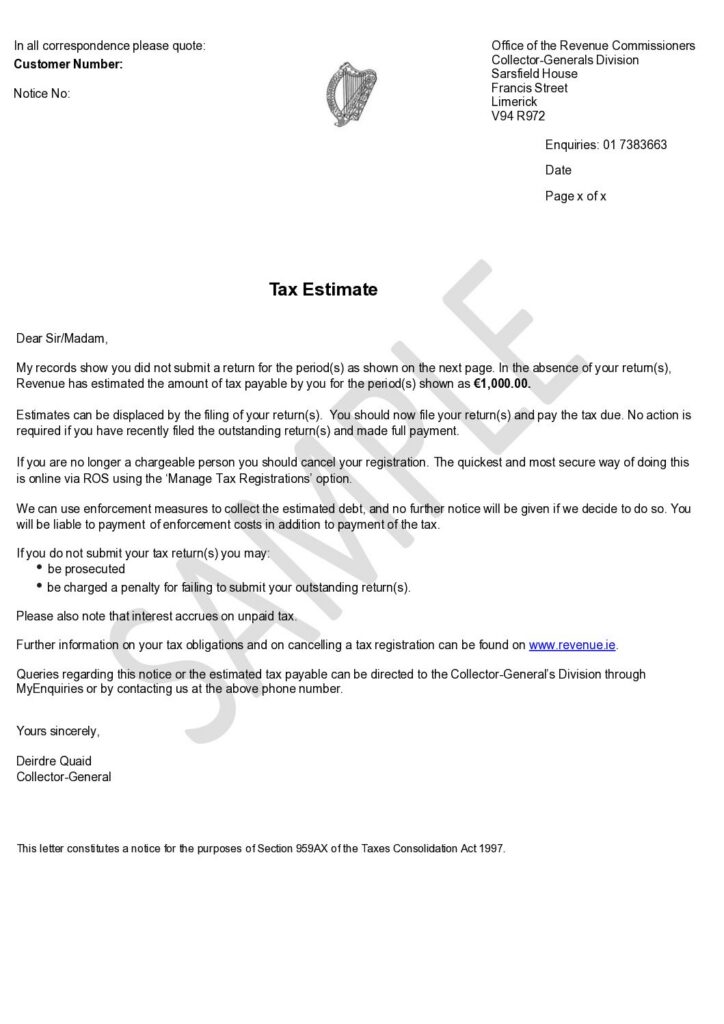
From Monday the 14th of September Revenue will issue nearly 85,000 estimates for 2024 where taxpayers have failed to file their return for that year. Of these, about 30,000 will issue to taxpayers with a linked agent on record. Of the total 67,500 will issue for the default estimated amount of €1,000.
The estimated tax for 2024 will be the greater of the average amount of tax due on the two most recent returns, or €1,000. Taxpayer or their agents, who file their 2024 tax returns, can get rid of the estimate by either filing the return or deregistering for Income Tax if no longer a chargeable person .
If no action is taken, beware. The estimated tax or €1,000 becomes pursuable and subject to enforcement 30 days from the date of the notice. Taxpayers who got an estimate have already been warned about this. They got a reminder in January 2026 to file their outstanding 2024 tax return.
Thankfully, this isn’t an issue for our practice as we filed all our clients 2024 tax returns already except for two cases. In both cases the clients passed away, and we couldn’t file them before the deadline due to not having access to records. One was filed a few months ago and the other will be filed shortly. We let Revenue know about both cases and there wasn’t an issue given the genuine and difficult circumstances. In fairness to Revenue, they didn’t apply the 10% surcharge for the return already file.
Looking at this, it pays to get your tax return done right and filed on time. This avoids surcharges, interest and wasted time. You must file a tax return anyway, so you may as well do it right and then you can sleep easy and forget about it. This is also a complete pain for accountants and tax agents up and down the country. More tax returns and dealing with Revenue on top of a hectic schedule of deadlines for 2025 Income Tax and corporation tax returns. Taxpayers can act the ostrich either. It’s your responsibility to get your tax returns in order and paid. Revenue will chase these estimates quickly after the 30 days are up. You’ll be getting demand and final demand letter and it’s over to the sheriff’s office then.
Final Demands
We came across two final demand cases that were a bit concerning. One shows how things can escalate fast for a small amount of money. The other shows a worrying level of incompetence at a Revenue level that a demand issued in the first place.
Imagine you are working from home and there’s a knock on the door. A stranger introduces himself.
“I’m from the Sherrif’s office and I’m here to collect €500”
It wasn’t our client answering the door, but her partner. The liability arose from a VAT estimate raised by Revenue. She didn’t file her May June 2026 VAT return which resulted in Revenue raising an estimate for €500. They didn’t pay the €500 and Revenue issued a demand letter. I’m not 100% certain if it went to the sheriff’s office then or if a final demand issued. Either way, it winged its way to the sheriff very quickly and then to the bailiff to collect.
The client was looking after her own VAT return but not doing a very good job. Ger got this sorted very quickly for her by deregistering her business for VAT from the end of April 2026. The turnover in her company was below the VAT registration threshold. By deregistering the return would no longer be due. The only costs to pay were the sheriff’s fees but this is an episode that could have been avoided.
Second Case
The second case involved yours truly who had filed a clients Income Tax return Form 11 for 2025 recently. This is a married couple who are jointly assessed to tax. As part of their 2025 tax return, I completed the Capital Gains Tax section of the return. The client’s wife sold shares in 2025 with a large CGT liability of about €475,000. She paid that on time by the 15th of December 2025. However, we still had to file the CGT return which we did as part of the 2025 Form 11. We completed the CGT self-assessment section, and all the numbers tied in. The liability matched the payment made. Revenue issued the self-assessment letter for Income Tax and CGT a few days after filing the return. An Income Tax refund due and the CGT all in line with the numbers submitted. That’s the end of it then.
Not so. Next thing a demand letter issues with the client’s name on it. As mentioned, we see that a demand letter has issue but don’t know the tax, but it had to be the CGT. Revenue were looking for another €475,000. They didn’t pick it up that it was already paid. To me, this is beyond shocking and just bizarre. Issuing a demand letter to a client when you’ve already paid them. It’s actually embarrassing and even places us in a bad light.
How come I’m getting letter from Revenue saying that we owe them this money when I paid them 10 months ago? We did everything right and still look bad. It’s clear from the CGT section of the return that the client’s wife sold the shares. Her tax number is on the tax return, and she made the payment under her tax number. Yet, Revenue are issuing a demand letter after not even doing the most basic of checks.
We get onto Revenue through My Enquiries and don’t get an answer. Days pass and nothing. The clients get a final demand letter. We call Revenue and the penny finally drops. They see that the client paid the liability. Crises over but again the client and our time wasted sorting out an issue that shouldn’t be an issue.
Summary
In summary of all this good news, Revenue are back from their summer holidays and in full tax demand and collection mode. I think I won’t post this blog until Tuesday for fear of depressing you all for the weekend. Remember you can put any old crap in a tax return, but that wouldn’t be the right thing to do. You’ll end up paying what you owe anyway and more!
We can all be busy fools at times. If you’re business is growing and you want things done right, think about outsourcing your bookkeeping function. By doing this as the song goes
“If you get it wrong, you’ll get it right next time”
Do you need help with your business numbers and taxes? If so, start here